What Evidence From the Text Leads You to Believe That the Dagger Macbeth Sees Is an Illusion
Themes
Macbeth introduces us to the savage and superstitious world of medieval, feudal Scotland. Nonetheless, some of the themes that Shakespeare highlights are nevertheless relevant in the 21st century.
Appearances and reality in Macbeth
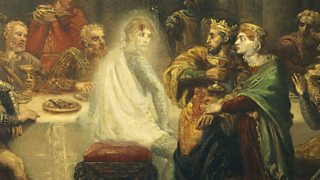
In Macbeth , things are never quite what they seem. Characters say ane thing nevertheless mean something else and use euphemisms to hibernate reality. Wicked and violent acts such as murder are covered up or the blame is shifted onto someone else. The Witches mislead Macbeth, or they at least make suggestions which allow him to mislead himself. Ghosts, visions and apparitions occur regularly. All of these things contribute to the many contrasts which exist in the play; virtually cipher is as information technology should be.
How is this shown in the play?
In Macbeth , Shakespeare examines how appearances tin can be deceptive and that the reality behind them is frequently unpleasant. Some of the key aspects are:
- seeing things
- sleep and dreams
- fake hospitality
| How does Shakespeare show this? | Show | Analysis | |
|---|---|---|---|
| Seeing things | The play is total of spirits, ghosts, optical illusions and visions. While some of these are conjured up by the Witches, others are as a upshot of a guilty conscience post-obit acts of wickedness. This is why Macbeth and Lady Macbeth are particularly affected . It is difficult for them to acknowledge to others (or even each other) what is happening - this might mean they would be suspected of madness. | Mine eyes are made the fools o'thursday'other senses, / Or else worth all the rest. I encounter thee still, / And on thy blade and dudgeon gouts of claret, / Which was not and so before. There's no such affair: / It is the bloody business concern which informs / Thus to mine optics. (Act 2 Scene 1) | In one of the well-nigh famous scenes in the play, Macbeth sees a vision of a dagger merely similar the ane he is most to utilize to kill male monarch Duncan. Blood is covering the blade and the dudgeon (handle). Lady Macbeth thinks her hands are covered in blood. Even though Macbeth cannot believe his eyes ('Mine eyes are fabricated the fools o'th'other senses') and in reality realises he is having an hallucination ('There's no such thing') he is all the same fascinated past the dagger's appearance . |
| Sleep and dreams | Afterward the murder of Duncan has taken identify, both Macbeth and his wife have trouble sleeping and are tormented by guilty dreams . Lady Macbeth regularly sleepwalks and replays events in her mind equally she tries to wipe abroad the retentivity of what she has washed. Somewhen she goes mad and she dies, probably by committing suicide. | LADY MACBETH: The Thane of Fife had a married woman. Where is she at present? What, will these hands ne'er be clean? No more than o'that, my lord, no more o'that. You mar all with this starting. Medico: Get to, go to; You have known what you lot should not. GENTLEWOMAN: She has spoke what she should non, I am sure of that. Heaven knows what she has known. (Deed five Scene 1) | The Physician and ane of the ladies-in waiting observe Lady Macbeth as she sleepwalks and goes over events in her mind. She is thinking near the murders of Macduff's wife and of King Duncan and how Macbeth reacted when he saw Banquo'southward ghost. These events all go muddled together in i continuous speech which suggests that Lady Macbeth is losing her reason. The blood on her hands is, of form, non real but in her highly charged emotional land she imagines that it is ('What, will these hands ne'er exist make clean?'). Her unconscious words and actions requite her abroad to the people watching. |
| Hospitality | Rex Duncan is a guest in the Macbeth's abode when they make up one's mind to murder him. Rather than look subsequently him as skilful hosts should do they transport him to his grave. Later in the play the Macbeths host a banquet for the other Thanes . They are non just being generous - their hidden calendar is to get the other nobles to support them. | MACBETH: You know your own degrees, sit down; at first and last, the hearty welcome. [The LORDS sit] LORDS: Thanks to your majesty. MACBETH: Our self will mingle with club and play the humble host; our hostess keeps her state, but in all-time fourth dimension we will crave her welcome. LADY MACBETH: Pronounce it for me, sir, to all our friends for my middle speaks, they are welcome. (Act three Scene iv) | Macbeth subtly reminds his guests that they all have a particular rank ('you know your own degrees') and that he is at the acme as Rex. Cleverly he pretends to 'play the apprehensive host' to make them less suspicious of his motives . The Macbeths announced to be putting on a bear witness of solidarity for the Thanes. In fact Macbeth has only ordered the murder of one of them (Banquo) and has refused to tell his married woman what he has been doing. Their words are very polite and apparently warm. The word 'welcome' appears three times which is nigh overdoing it! |
Analysing the evidence
- Question
-
How is the theme of appearances and reality presented in the play?
-
- Through characters' language - Many of the words the characters employ have double meanings, are twisted for a item purpose or are used to highlight contrasts (eg "So foul and fair a day I have not seen")
- Through characters' thoughts - The Macbeths have evil intentions and fifty-fifty when they seem friendly and welcoming are often actually plotting how they tin can hold onto their power (eg when Duncan is welcomed into their castle equally an honoured guest)
- Through characters' actions - Acts of pure evil are presented as though they are somehow benign to others (eg when Macbeth orders Banquo's death, he suggests to the hired murderers that it will exist of benefit to them)
Source: https://www.bbc.co.uk/bitesize/guides/zpms82p/revision/4

Post a Comment for "What Evidence From the Text Leads You to Believe That the Dagger Macbeth Sees Is an Illusion"