Find the Annual Rate of Return Liberal Arts Math
Learning Outcomes
- Calculate 1-time simple interest, and simple interest over time
- Determine APY given an involvement scenario
- Summate chemical compound interest

We have to work with money every day. While balancing your checkbook or calculating your monthly expenditures on espresso requires only arithmetic, when we start saving, planning for retirement, or need a loan, we need more mathematics.
Simple Interest
Discussing involvement starts with the principal, or amount your account starts with. This could be a starting investment, or the starting amount of a loan. Interest, in its most simple form, is calculated every bit a percent of the principal. For example, if you borrowed $100 from a friend and agree to repay it with 5% interest, and so the corporeality of interest you would pay would just be v% of 100: $100(0.05) = $v. The full amount you would repay would be $105, the original chief plus the interest.

Simple 1-time Interest
[latex]\brainstorm{align}&I={{P}_{0}}r\\&A={{P}_{0}}+I={{P}_{0}}+{{P}_{0}}r={{P}_{0}}(1+r)\\\end{align}[/latex]
- I is the involvement
- A is the end amount: principal plus involvement
- [latex]\begin{align}{{P}_{0}}\\\end{marshal}[/latex] is the principal (starting corporeality)
- r is the interest rate (in decimal form. Instance: v% = 0.05)
Examples
A friend asks to borrow $300 and agrees to repay it in 30 days with iii% interest. How much interest will you earn?
The post-obit video works through this instance in item.
1-fourth dimension simple interest is only mutual for extremely short-term loans. For longer term loans, it is mutual for interest to be paid on a daily, monthly, quarterly, or annual footing. In that case, involvement would be earned regularly.
For instance, bonds are essentially a loan made to the bond issuer (a company or authorities) by you, the bond holder. In return for the loan, the issuer agrees to pay interest, ofttimes annually. Bonds have a maturity date, at which time the issuer pays back the original bail value.
Exercises
Suppose your city is building a new park, and issues bonds to raise the coin to build it. You obtain a $1,000 bond that pays 5% interest annually that matures in 5 years. How much interest will you earn?
Show Solution
Each year, you would earn 5% involvement: $1000(0.05) = $fifty in interest. So over the course of v years, you would earn a total of $250 in involvement. When the bond matures, you would receive dorsum the $i,000 you originally paid, leaving you with a total of $ane,250.
Farther explanation about solving this example tin be seen here.
We tin can generalize this thought of unproblematic interest over fourth dimension.
Simple Involvement over Time
[latex]\begin{align}&I={{P}_{0}}rt\\&A={{P}_{0}}+I={{P}_{0}}+{{P}_{0}}rt={{P}_{0}}(1+rt)\\\end{align}[/latex]
- I is the interest
- A is the end amount: principal plus interest
- [latex]\brainstorm{align}{{P}_{0}}\\\cease{align}[/latex] is the principal (starting amount)
- r is the interest rate in decimal course
- t is fourth dimension
The units of measurement (years, months, etc.) for the fourth dimension should match the time period for the interest rate.
APR – Annual Percentage Rate
Interest rates are commonly given equally an annual percentage charge per unit (Apr) – the full interest that will be paid in the twelvemonth. If the interest is paid in smaller time increments, the Apr will be divided upwards.
For case, a 6% APR paid monthly would be divided into twelve 0.5% payments.
[latex]six\div{12}=0.5[/latex]
A 4% annual rate paid quarterly would be divided into iv 1% payments.
[latex]4\div{iv}=1[/latex]
Example
Treasury Notes (T-notes) are bonds issued by the federal government to cover its expenses. Suppose you obtain a $1,000 T-note with a 4% annual rate, paid semi-annually, with a maturity in four years. How much interest will you earn?
This video explains the solution.
Try It
Try It
A loan company charges $thirty involvement for a 1 month loan of $500. Find the annual interest charge per unit they are charging.
Effort It
Compound Involvement
With simple involvement, we were assuming that nosotros pocketed the interest when we received it. In a standard bank business relationship, any involvement we earn is automatically added to our balance, and we earn interest on that involvement in future years. This reinvestment of interest is called compounding.

Suppose that nosotros deposit $1000 in a depository financial institution account offering three% interest, compounded monthly. How will our money abound?
The 3% involvement is an annual percentage rate (APR) – the total involvement to be paid during the yr. Since interest is being paid monthly, each month, nosotros volition earn [latex]\frac{3%}{12}[/latex]= 0.25% per month.
In the start month,
- P0 = $g
- r = 0.0025 (0.25%)
- I = $thou (0.0025) = $2.l
- A = $1000 + $ii.fifty = $1002.l
In the start month, we will earn $2.l in interest, raising our business relationship residuum to $1002.fifty.
In the 2d month,
- P0 = $1002.50
- I = $1002.50 (0.0025) = $2.51 (rounded)
- A = $1002.50 + $2.51 = $1005.01
Detect that in the 2nd month we earned more interest than nosotros did in the outset calendar month. This is because we earned involvement not only on the original $1000 we deposited, but we as well earned involvement on the $2.50 of interest nosotros earned the beginning month. This is the fundamental reward that compounding involvement gives us.
Computing out a few more months gives the following:
| Month | Starting balance | Involvement earned | Ending Balance |
| 1 | 1000.00 | 2.50 | 1002.50 |
| ii | 1002.50 | ii.51 | 1005.01 |
| iii | 1005.01 | two.51 | 1007.52 |
| 4 | 1007.52 | 2.52 | 1010.04 |
| 5 | 1010.04 | 2.53 | 1012.57 |
| six | 1012.57 | two.53 | 1015.x |
| 7 | 1015.10 | two.54 | 1017.64 |
| 8 | 1017.64 | 2.54 | 1020.18 |
| 9 | 1020.xviii | 2.55 | 1022.73 |
| 10 | 1022.73 | 2.56 | 1025.29 |
| 11 | 1025.29 | 2.56 | 1027.85 |
| 12 | 1027.85 | 2.57 | 1030.42 |
We desire to simplify the procedure for calculating compounding, because creating a tabular array like the ane above is time consuming. Luckily, math is adept at giving you means to take shortcuts. To notice an equation to represent this, if Pgrand represents the corporeality of money after m months, and then we could write the recursive equation:
P0 = $1000
Pg = (1+0.0025)Pm-i
You probably recognize this equally the recursive form of exponential growth. If not, we go through the steps to build an explicit equation for the growth in the next example.
Example
Build an explicit equation for the growth of $m deposited in a bank business relationship offering three% interest, compounded monthly.
View this video for a walkthrough of the concept of compound interest.
While this formula works fine, it is more than common to employ a formula that involves the number of years, rather than the number of compounding periods. If North is the number of years, and then 1000 = N one thousand. Making this change gives us the standard formula for compound involvement.
Compound Involvement
[latex]P_{Due north}=P_{0}\left(1+\frac{r}{g}\right)^{Nk}[/latex]
- PNorthward is the balance in the account after Northward years.
- P0 is the starting remainder of the account (likewise called initial deposit, or principal)
- r is the almanac interest charge per unit in decimal form
- k is the number of compounding periods in ane yr
- If the compounding is done annually (in one case a yr), k = 1.
- If the compounding is done quarterly, 1000 = 4.
- If the compounding is done monthly, thou = 12.
- If the compounding is done daily, k = 365.
The most of import thing to retrieve about using this formula is that it assumes that nosotros put money in the account in one case and permit information technology sit there earning involvement.
In the next example, nosotros bear witness how to use the compound interest formula to find the balance on a certificate of deposit after 20 years.
Example
A certificate of eolith (CD) is a savings musical instrument that many banks offer. It commonly gives a higher interest rate, only yous cannot access your investment for a specified length of fourth dimension. Suppose you lot deposit $3000 in a CD paying six% involvement, compounded monthly. How much will yous have in the business relationship afterward 20 years?
A video walkthrough of this instance problem is available below.
Let us compare the amount of money earned from compounding against the amount you would earn from simple interest
| Years | Simple Interest ($15 per month) | 6% compounded monthly = 0.5% each month. |
| 5 | $3900 | $4046.55 |
| 10 | $4800 | $5458.nineteen |
| 15 | $5700 | $7362.28 |
| 20 | $6600 | $9930.61 |
| 25 | $7500 | $13394.91 |
| thirty | $8400 | $18067.73 |
| 35 | $9300 | $24370.65 |
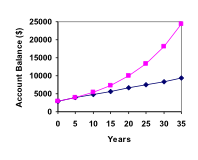
Every bit y'all can run across, over a long flow of fourth dimension, compounding makes a large difference in the account residuum. You may recognize this as the difference between linear growth and exponential growth.
Try It
Evaluating exponents on the figurer
When we need to summate something like [latex]5^three[/latex] it is easy enough to only multiply [latex]5\cdot{5}\cdot{5}=125[/latex]. But when we demand to calculate something like [latex]one.005^{240}[/latex], it would be very slow to summate this by multiplying [latex]1.005[/latex] by itself [latex]240[/latex] times! So to make things easier, we can harness the power of our scientific calculators.
Most scientific calculators have a button for exponents. It is typically either labeled like:
^ , [latex]y^ten[/latex] , or [latex]10^y[/latex] .
To evaluate [latex]1.005^{240}[/latex] we'd type [latex]1.005[/latex] ^ [latex]240[/latex], or [latex]1.005 \space{y^{ten}}\space 240[/latex]. Try it out – you should get something around 3.3102044758.
Case
You know that y'all will demand $40,000 for your child'south education in 18 years. If your account earns four% compounded quarterly, how much would you need to deposit now to reach your goal?
Endeavor It
Rounding
It is important to be very conscientious about rounding when calculating things with exponents. In general, you lot want to keep as many decimals during calculations as you can. Be sure to continue at least three significant digits (numbers after any leading zeros). Rounding 0.00012345 to 0.000123 will usually requite you a "close plenty" answer, but keeping more digits is always meliorate.
Example
To meet why not over-rounding is so of import, suppose you were investing $1000 at v% involvement compounded monthly for 30 years.
| P0 = $k | the initial eolith |
| r = 0.05 | 5% |
| k = 12 | 12 months in one twelvemonth |
| North = xxx | since we're looking for the amount after 30 years |
If we first compute r/k, we observe 0.05/12 = 0.00416666666667
Here is the outcome of rounding this to different values:
| r/k rounded to: | Gives Pxxx to be: | Fault |
| 0.004 | $4208.59 | $259.15 |
| 0.0042 | $4521.45 | $53.71 |
| 0.00417 | $4473.09 | $v.35 |
| 0.004167 | $4468.28 | $0.54 |
| 0.0041667 | $4467.80 | $0.06 |
| no rounding | $4467.74 |
If yous're working in a depository financial institution, of form you wouldn't round at all. For our purposes, the answer we got by rounding to 0.00417, 3 significant digits, is close enough – $5 off of $4500 isn't too bad. Certainly keeping that 4th decimal identify wouldn't take injure.
View the following for a sit-in of this instance.
Using your calculator
In many cases, you can avoid rounding completely by how you enter things in your calculator. For example, in the example above, we needed to calculate [latex]{{P}_{30}}=1000{{\left(1+\frac{0.05}{12}\right)}^{12\times30}}[/latex]
We can quickly calculate 12×30 = 360, giving [latex]{{P}_{xxx}}=1000{{\left(i+\frac{0.05}{12}\right)}^{360}}[/latex].
At present we tin employ the estimator.
| Blazon this | Computer shows |
| 0.05 ÷ 12 = . | 0.00416666666667 |
| + 1 = . | 1.00416666666667 |
| yx 360 = . | 4.46774431400613 |
| × 1000 = . | 4467.74431400613 |
Using your computer continued
The previous steps were bold you have a "i operation at a time" calculator; a more advanced calculator will often permit you to type in the entire expression to be evaluated. If you have a calculator like this, you will probably just need to enter:
1000 × ( 1 + 0.05 ÷ 12 ) yx 360 =
Solving For Time
Note: This section assumes you've covered solving exponential equations using logarithms, either in prior classes or in the growth models chapter.
Often we are interested in how long information technology volition take to accumulate money or how long nosotros'd need to extend a loan to bring payments down to a reasonable level.
Examples
If yous invest $2000 at 6% compounded monthly, how long will it take the business relationship to double in value?
Become boosted guidance for this example in the post-obit:
Source: https://courses.lumenlearning.com/wmopen-mathforliberalarts/chapter/introduction-how-interest-is-calculated/

Post a Comment for "Find the Annual Rate of Return Liberal Arts Math"