Wouldn’t it be great if our Planning Commission were given more power?
Planning To The Rescue
Wouldn't it be keen, Philly 3.0's date director wonders, if our advisory-only Planning Commission were given more than power?
Jan. 12, 2020


There'south already been a lot of attention on Mayor Jim Kenney's last-infinitesimal pocket veto of the Drexel food-truck ban, where by declining to sign the beak, it expired at the end of Council's term instead of passing into police.
THIS Commodity IS PART OF A CONTENT PARTNERSHIP WITH:

The food truck ban was one of six bills that Mayor Kenney pocket-vetoed at the cease of the term, and the Planning Commission also cancelled a few as we noted in our end-of-term wrap-up:
 A few other bills did not advance. As Jake Blumgart reported, the Planning Committee used their power to force a 45-day filibuster to spike a pecker from Brian O'Neill that would ban roof decks and set up dissimilar lower elevation limits throughout his Northeast Philly district. Because the 45-day filibuster would kicking the neb into 2020, and the term ends in January, that kills the pecker for this term. O'Neill can still bring it back in the next term and it'll probably pass since the Planning Committee'southward recommendations are, unfortunately, advisory-only.
Planning besides spiked a neb from Society Hill that would have fabricated numerous changes including reducing development rights in the area near the Ritz V theater and Positano Coast (presumably in response to the by-right approval of 300 apartments at the Sheraton hotel) and exempting the neighborhood from the new celebrated preservation incentives, which include relief from parking requirements, allowance of Accessory Dwelling Units, and easier residential conversion of industrial and institutional properties. Section of Planning and Evolution head Anne Fadullon reportedly panned the nib as "exclusionary" according to sources who attended. This too tin come back next term, if Councilmember Marking Squilla volition innovate information technology over again over Planning's objections.
The assistants released a memo explaining their pocket vetoes which is worth a read because of how information technology highlights the positive influence of the Planning Committee in a rare case where they had some ability over the process, and why information technology would be a good idea for them to accept even more ability during the regular grade of business, relative to Metropolis Quango.
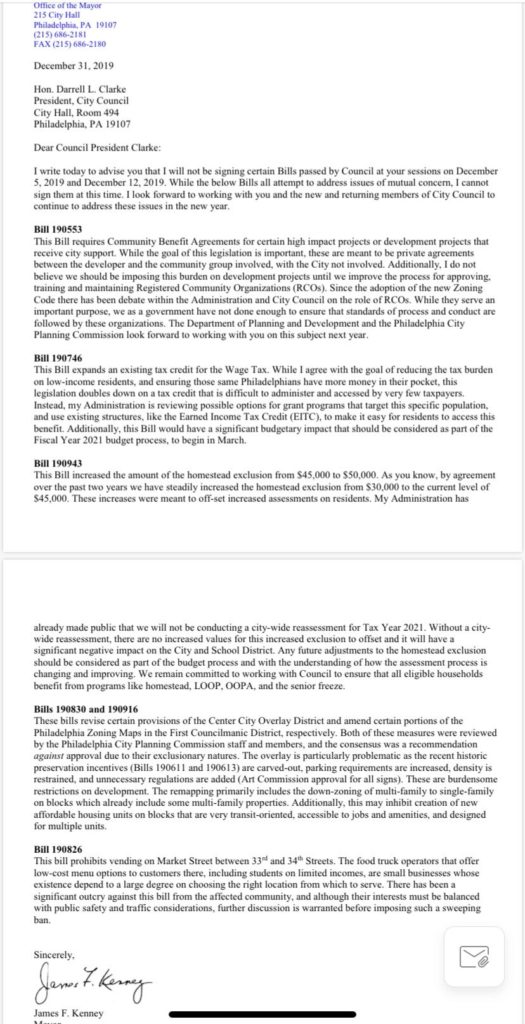
The cardinal sections here concern the vetoes of bills 190553, 190830 and 190916.
The first department about the Community Benefit Agreements bill (190553) recognizes some of the big problems with the Registered Customs Organisation (RCO) procedure that City Council typically doesn't call up very critically almost. Community Benefit Agreements can exist good, depending on the details, but they can likewise just exist a manner for local property owners to shake downwardly projects—even public projects!—for unrelated civilities that take piffling to do with the project's impact.
The Council bill, introduced by Darrell Clarke, just assumes that all RCOs would operate with a certain level of integrity, but as the mayor'south comments hint at ever-so-tactfully, at that place are almost no quality controls that the City imposes on these organizations every bit a condition for blessing.
 The Planning Commission has to approve most anybody who applies for RCO status if they come across sure, very minimal qualifications. Since even partisan Democratic or Republican ward organizations can and do acquire official RCO status with the Urban center, equally well as clear front groups for outside interests in the case of the West Philly Pride and Kingsessing Spirit RCOs, the opportunities for corrupt dealings created by a mandatory Community Do good Agreement framework should exist obvious to everyone.
Then it'south keen to meet the Kenney administration, and the Planning Commission who approves the RCOs, gesturing in the direction of further rounds of RCO reform in the new term to create more public accountability there. For context, some other cities are really dismantling these kinds of neighborhood power structures as an official office of the planning and zoning process, recognizing that they tend to amplify the opinions of a very unrepresentative and relatively privileged segment of the population. This is one surface area where nosotros could really apply a stronger Planning Commission with a freer mitt to rebalance the City's public outreach process with an centre toward gathering more representative opinions.
The other department of involvement is the Society Colina rezoning veto, where Mayor Kenney, informed by Planning'south position opposing the bills, objects to the exclusionary nature of that legislation in a neighborhood that always seems to get whatsoever special handling they ask for:
[R]ecent historic preservation incentives… are carved-out, parking requirements are increased, density is restrained, and unnecessary regulations are added. These are crushing restrictions on development. The remapping primarily includes the down-zoning of multi-family to single-family on blocks which already include some multi-family properties. Additionally, this may inhibit the creation of affordable housing units on blocks that are very transit-oriented, accessible to jobs and amenities, and designed for multiple units.
It'due south a reminder that these kinds of arguments for special snowflake condition are only really going to deport weight with a District councilmember. From the perspective of somebody like the mayor or an at-big councilmember who gets elected citywide, they're much less compelling, and more ofttimes objectionable.
From the mayor's perspective, more than housing construction in wealthier areas of the city means more jobs and tax revenue and more people who tin can live close to downtown jobs, which is correct in line with their high-level planning, affordability and environmental priorities.
Unfortunately, the mayor and the Planning Committee only had this kind of power this time because they were reviewing the bills at the finish of the Council term, which only happens once every 4 years. Only this is simply the example because of an unfortunate detail of the Urban center Lease, where Planning Commission opinions are advisory-only, even though other Commission decisions—like the Art Commission, for case—are actually the concluding say on matters.
It would be an enormous improvement to local politics if the Charter were changed to brand the Planning Commission's decisions binding too, so that they would e'er have veto power over rezoning bills, lawmaking changes and metropolis plan amendments, and would be constantly looming over land-use debates as a hard backstop to any bad ideas coming out of Council.
As interest has been building around a Metropolis Lease rewrite, irresolute Planning Committee recommendations from advisory to bounden would be a critical move for weakening councilmanic prerogative and holding the City accountable to important large-film policy goals for climate change, affordable housing, and more.
In the concurrently, one of our New Year resolutions for 2022 is to see more of this kind of rhetorical verve from Planning and the mayor on housing and planning bug, and more assertive policy entrepreneurship that doesn't just relinquish the whole policy agenda and the public narrative around planning to Metropolis Council.
Jon Geeting is the managing director of engagement at Philadelphia 3.0 , a political action committee that supports efforts to reform and modernize City Hall. This is part of a serial of articles running on both The Citizen and three.0'due south web log .
Want more? Bank check out these related articles:
- Philadelphia is richer than it was in 2016. So where'south all that money going?
- The mayor's zoning board is making bad decisions counter to the his ain plans for the metropolis
- The opposite of councilmanic prerogative is non rocket science—information technology's planning

Source: https://thephiladelphiacitizen.org/planning-commission-power/
Post a Comment for "Wouldn’t it be great if our Planning Commission were given more power?"