Movie That Made Ragtime Music Popular Again in 1970s
Reading on mobile? Click hither to listen to The Maple Leaf Rag played by Scott Joplin
One album was all it took to herald a revival. In 1970, the twelvemonth of Simon & Garfunkel'south Span Over Troubled Water and The Beatles' Permit It Be, a record of arcane belatedly 19th-century American piano music, released on a label that was otherwise edifice its reputation as a chronicler of the hardcore American avant-garde, began to sell in implausible quantities. Audiences commonly enamoured of pianoforte miniatures by Chopin, Brahms and Liszt were all of a sudden taking pleasance in the compositions of Scott Joplin, the Texas-born "King of Ragtime" whose über-catchy 1899 Maple Leaf Rag brought him immediate popularity, but who died in 1917 with ii typically embarrassing composerly bug hanging over him: syphilis and a terminally unproduced opera, Treemonisha, which would merely exist recognised as a masterwork long subsequently his death.
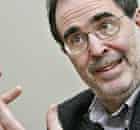
Joshua Rifkin, an upward-and-coming pianist in 1970, had ragtime brought to his attending past the composer William Bolcom and the evangelising jazz writer Rudi Blesh. Rifkin persuaded the New York-based Nonesuch characterization to act on his hunch that the trickster melodies and brain-worm syncopations feature of ragtime pieces – decked out with such whimsical titles equally The Entertainer, Heliotrope Bouquet and Swipesy – would entreatment direct to the hearts and minds of classical pianoforte buffs. But neither pianist nor tape label could have foreseen the itchy enthusiasm for this once popular merely long-since forgotten music that would mushroom across the United States and beyond.
In terms of fourth dimension and historical distance, if not exactly musical content, an equivalent discovery today would see the mainstream media suddenly fixate on bebop; The One Testify's Gyles Brandreth recalled from catching up with authentic jam-making in Dorset to discuss the intricacies of menses Charlie Parker records. That's the force with which ragtime percolated deep inside American civilisation. Woody Allen gave his 1973 motion picture Sleeper a ragtime soundtrack. EL Doctorow chosen his latest novel Ragtime. Film director George Roy Hall underscored his wisecracking card-hustler movie The Sting with Joplin rags.
Reading on mobile? Click here to listen to The Sting soundtrack
Pre-Spotify – and pre-Simon Cowell – wildcard albums had leeway to punch in a higher place their market place weight; Scott Joplin could and did nautical chart alongside The Beatles. But if Rifkin brought ragtime to hundreds of thousands of people, the Oscar-wining The Sting catapulted the music into the mainstream. With visionary prescience in 1915, Joplin proclaimed "l years after I'chiliad dead my music volition be appreciated." He was only out by a few years, but ragtime's consummate identification in the popular imagination with The Sting became difficult. Hither was ragtime dressed in fancy instrumentations, dolled upwards to the orchestral nines by moving-picture show composer Marvin Hamlisch; rags no longer grinning innocently, but lent an insincere Hollywood grin.
Joplin's mantra would never waver: appreciation of his sleights-of-hand – notes never quite falling into the patterns you look – relied on savouring each moment. Past rushing his tempos, he said in his School of Ragtime primer, "very often good players lose the effect entirely." But the high-energy hokum of The Sting recast ragtime as Keystone Kops crazy-chase music by default, an unhappy paradox given that George Roy Hall was introduced to rags via Rifkin'due south recordings – interpretations rooted in his insistence on treating Joplin with the same faithful respect afforded to a Chopin Mazurka or a Brahms Waltz.
"Rag" as in "tease", and then ragtime is literally "tease time". Hearing Joplin'south signature composition "The Entertainer" today is similar the warm glow of a comedian'due south dependable catchphrase; it'due south always nice to hear information technology nice. Other Joplin compositions, though, reveal their tease merely gradually. My own fascination with Heliotrope Bouquet has at times bordered on obsession. My musician'south brain that can fully rationalise Joplin's harmonic moving parts, but that nuts-and-bolts analysis actually tells you petty about its true emotional sting. Counterbalanced flawlessly in an emotional fault line between forlorn melancholy and aching wistfulness, this piece wears smiles y'all only see once they have already begun to fade. This is Peggy Lee'south tart Is That All There Is? decades before the event. Or music that mirrors Schubert's trademark harmonic polysemousness – and all neatly contained within a four-minute structure.
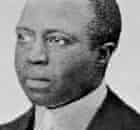
The letter of a Joplin score must be obeyed. Rifkin'due south intuition has long since been vindicated, although questions remain about where ragtime stands historically in relation to jazz. The scholar Terry Waldo argued, in his superb 1976 book This Is Ragtime, that the music presented a sonic metaphor for the day-to-day experience of early 20th-century Black America, the melodic liberation of the correct-mitt endeavouring to undermine the left-hand's slavish regularity. And although jazz musicians of a sure mindset would eagerly accommodate ragtime to their own improvisational ends – Sidney Bechet'south 1932 Maple Leaf Rag is a true jazz masterpiece – my own hunch is that Joplin's music was anyway inherently improvisational.
Rags had the same identikit structure. Looped 16-bar phrases always gravitated back towards the habitation primal, but merry-legged melodic lines took sharp, unforeseen corners, drunk on their own invention; Joplin was improvising on the page. Simply modern jazzmen were surely also darn cool to admit these frivolous compositional follies? Well, actually no. Thelonious Monk shamelessly mined ragtime and stride piano, reshaping its raw energies. And John Coltrane'due south compressed, sped-up saxophone lines – his so-called "sheets of sound" – built on Monk's palette of gestures. And Coltrane's example would galvanise Steve Reich and Jimi Hendrix – and The Doors and Evan Parker – and well-nigh every emerging jazz and rock musician of the 1960s and 70s – into activity, fuelling revolutions to come.
Source: https://www.theguardian.com/music/musicblog/2014/jan/22/scott-joplin-ragtime-josh-rifkin-the-sting

Post a Comment for "Movie That Made Ragtime Music Popular Again in 1970s"